


Emerging Sign Technology Trends for Businesses

A customer who cannot find your entrance, read your storefront from the street, or understand where to go next may never become a customer at all. That is why emerging sign technology trends matter to more than large national brands. For Sonoma County businesses, better sign technology can mean clearer visibility, easier navigation, stronger brand consistency, and signage that stays useful long after the initial installation.
The right solution is not always the newest or most complex one. A well-built set of channel letters or a properly placed monument sign can outperform an expensive digital display if it better suits the location, audience, and viewing distance. The real opportunity is using new capabilities where they solve a practical business problem.
Emerging Sign Technology Trends That Matter
Smarter LED illumination and lighting controls
LED lighting has been a standard choice for illuminated signs for years, but the technology continues to improve. Modern LEDs can deliver more even illumination, better color consistency, lower energy use, and longer service life than older lighting systems. For businesses with cabinet signs, channel letters, monument signs, or interior displays, those improvements affect both appearance and operating costs.
Lighting controls are becoming more useful as well. Timers, photocells, and programmable controls can turn signs on when they are needed and reduce unnecessary operating hours. A restaurant may want its exterior signage illuminated through closing time, while a professional office may need a different schedule. The goal is not simply to use less energy. It is to make sure your sign is working when customers are most likely to see it.
There are trade-offs. Controls and higher-spec components add upfront cost, and a poorly installed electrical system can create maintenance headaches. Businesses should consider access for future service, local sign ordinances, and how illumination will look from the road, not just from a design rendering.
Digital signs built for targeted information
Digital signage has moved beyond scrolling text boards. Commercial-grade displays can now present menus, promotions, event schedules, tenant directories, safety notices, and branded content with much greater flexibility than a static panel. For businesses that update information frequently, that flexibility can reduce the cost and delay of reprinting signs.
This is especially practical for hospitality, healthcare, retail, property management, schools, churches, and event venues. A digital lobby directory can be updated when tenants change. A showroom display can feature seasonal products. An event organizer can direct guests as schedules or room assignments shift.
Still, digital is not automatically better. Screens need an appropriate location, dependable power, a content plan, and someone responsible for keeping information current. Outdoor displays must also be selected for brightness, weather resistance, viewing angle, and local regulations. A screen with outdated information can hurt credibility faster than a static sign ever would.
Connected sign management for multi-location businesses
For businesses with several offices, retail locations, properties, or vehicles, one of the most valuable trends is centralized brand and sign management. Digital assets, fabrication specifications, color standards, and installation records can be organized so that future projects remain consistent.
This matters when a company adds a new location, replaces damaged signage, refreshes vehicle graphics, or updates a tenant directory. Rather than starting from scratch each time, the business can work from established standards. The result is a more professional appearance and fewer avoidable decisions during a time-sensitive project.
Connected management does not need to mean a complicated software rollout. Sometimes it simply means having a trusted local sign partner maintain accurate project records, approved artwork, paint colors, material specifications, and past installation details. That level of continuity is particularly helpful for property owners and facilities managers responsible for multiple signs over many years.
Better wayfinding through layered information
Wayfinding signs are becoming more thoughtful because businesses have recognized that navigation is part of customer service. A visitor should not have to guess where the reception desk is, which door is accessible, where to park, or how to reach a specific suite.
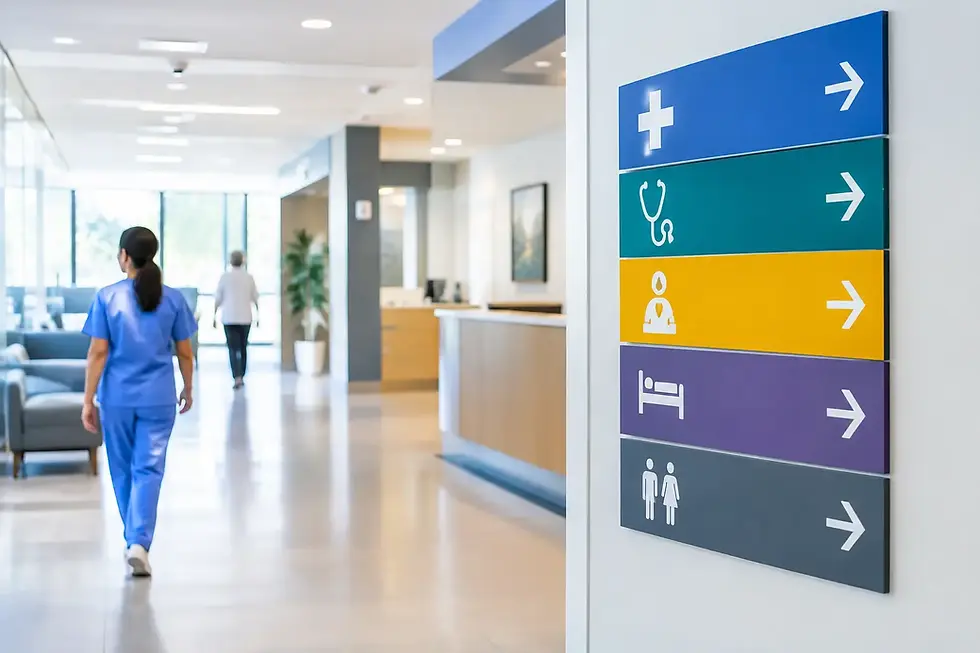
Modern wayfinding systems use a layered approach. Large exterior signs establish the destination. Monument signs and building identification confirm arrival. Directional signs guide vehicles and pedestrians. Interior directories, room signs, and ADA-compliant identification complete the path. Color coding, icons, typography, and placement all work together.
Technology supports this work through improved production methods, durable materials, digital directories, and design tools that make it easier to maintain consistency across a property. But the most effective wayfinding is still grounded in observation. It should reflect how real people enter, park, walk, and make decisions on site. A beautiful directory does little good if visitors cannot find it before they need it.
Advanced print materials and finishes
Large-format printing continues to expand what businesses can accomplish with vehicle graphics, window graphics, wall murals, banners, floor graphics, and trade show displays. Higher-resolution printing, improved laminates, specialty films, and more accurate color matching help graphics look more polished and hold up better in demanding environments.
For a contractor, a wrapped truck can make a strong advertising impression during every job, commute, and supply run. For a retail business, window graphics can promote an offer without blocking too much natural light. For an office or clinic, branded wall graphics can make a reception area feel established and intentional.
Material selection remains critical. The least expensive vinyl is not always the right choice for direct sun, textured walls, frequent cleaning, or long-term fleet use. Temporary event graphics need different materials than permanent exterior graphics. A knowledgeable sign company will ask where the graphic will be used, how long it needs to last, and what surface it will be applied to before recommending a solution.
Dimensional signs with more design precision
Fabrication technology has made dimensional signs more accessible and more versatile. Routed acrylic, formed plastic, aluminum, steel, wood, and layered combinations can create depth that flat signs cannot. Precision cutting and finishing also make it easier to produce clean, repeatable lettering, logos, and interior branding elements.
Dimensional lobby signs, exterior letters, donor walls, and monument signs are particularly effective because they create shadows, texture, and a sense of permanence. They can also be illuminated from the front, side, or back, depending on the desired effect and the site conditions.
The design should match the brand and the building. A law office, winery, medical practice, industrial contractor, and modern retailer may all benefit from dimensional signage, but the materials and finish should not look the same. Good sign design considers architecture, brand personality, visibility, maintenance, and budget together.
QR codes and mobile-connected signage
QR codes on signs, window graphics, displays, and event materials can give customers a quick path to a menu, appointment page, property listing, product details, or event registration. They are most effective when they provide a clear next step that is easier on a phone than on a sign.
For example, a real estate sign can direct prospects to a detailed listing. A trade show display can provide product information without overcrowding the design. A restaurant can offer a QR code for online ordering while still keeping its primary sign message clear.
The limitation is simple: a QR code is not a substitute for a readable sign. People need to understand the offer before they decide to scan. Codes should be large enough to use at the expected viewing distance, tested on multiple phones, and paired with a short explanation of what the visitor will receive.
How to Choose the Right Sign Technology
Before selecting a new sign system, start with the business objective. Are you trying to get noticed from a busy road, guide visitors through a complex property, update changing information, improve a dated storefront, or create a consistent look across locations? The answer should guide the technology, not the other way around.
A practical planning conversation should also address viewing distance, lighting conditions, local permitting, accessibility requirements, structural conditions, electrical needs, maintenance access, and the expected life of the sign. These details are where a promising concept becomes a sign that performs reliably in the field.
For many local businesses, the best investment is a combination: permanent exterior identification for daily visibility, clear directional and ADA signage for customer experience, and flexible printed or digital elements for promotions and changing information. This approach protects the long-term brand while allowing room for timely updates.
At Econoline Signs, the focus is on helping clients choose signage that fits the job, the property, and the future of the business. New technology should make your message clearer and your operation easier to manage. When it does, your signage keeps earning attention every day, even when your doors are closed.


Comments