


Custom Business Signs for Wall That Work

A blank wall inside your business is rarely just a wall. It is often the first thing a customer sees when they walk in, the backdrop behind your reception team, or the surface that quietly tells people whether your company feels polished, trustworthy, and established. That is why custom business signs for wall applications deserve more thought than many businesses give them.
For some companies, a wall sign is about branding. For others, it is about helping visitors find their way, reinforcing professionalism in a lobby, or making a retail space feel more intentional. The right sign can do all of that at once. It becomes part of the customer experience while also working as a durable advertising asset every day your doors are open.
Why custom business signs for wall spaces matter
Wall signage does more than fill empty space. It helps shape perception. A well-made lobby logo sign tells clients they are dealing with an organized business that pays attention to details. A clean directional sign in a hallway reduces confusion. A branded wall display in a showroom can support sales without asking your staff to say a word.
This is one reason wall signs deliver such practical value. They are not temporary decor. They support branding, navigation, and communication in a way that continues working over time. Compared with many forms of advertising, they are also cost-effective because the message stays in place and keeps making impressions.
There is also a difference between a generic sign and a custom one. Off-the-shelf options may cover a basic need, but they rarely reflect your brand accurately. Custom wall signage allows you to match color, scale, materials, fonts, and placement to your space and your business goals. That difference is visible right away.
What a good wall sign should accomplish
The best wall signs are built around purpose, not just appearance. In one space, the goal may be a strong branded focal point behind a front desk. In another, the priority may be ADA compliance, room identification, or consistent wayfinding across a larger building.
A sign can look impressive and still miss the mark if it is too small, poorly placed, hard to read, or made from materials that do not fit the environment. A law office lobby, medical facility, winery tasting room, retail shop, and industrial office all need something different. Good signage starts by understanding how the wall will be used and what people need from it.
That is where planning matters. The right size depends on viewing distance. The right material depends on lighting, traffic, and the look you want to create. The right mounting method depends on the wall surface itself, whether that is drywall, brick, metal, glass, or another finish.
Popular types of custom business signs for wall use
There is no single best wall sign for every business. The right solution depends on brand style, budget, building conditions, and how permanent the sign needs to be.
Dimensional letter signs are a strong choice for lobbies, reception areas, and conference rooms. These signs create depth and shadow, which gives a polished, architectural feel. Materials may include acrylic, PVC, metal, or laminate, and each one changes the final look. Acrylic often feels clean and modern, while metal can read as more premium or formal.
Flat panel signs are another common option. These can carry logos, tenant information, directories, branded graphics, or informational content. They work well when you need a crisp, straightforward display with room for more text.
Wall graphics and vinyl lettering are often a good fit when businesses want a large visual impact without heavier fabrication. They are useful for mission statements, environmental branding, promotional messaging, and interior graphics in offices, schools, retail spaces, and event settings.
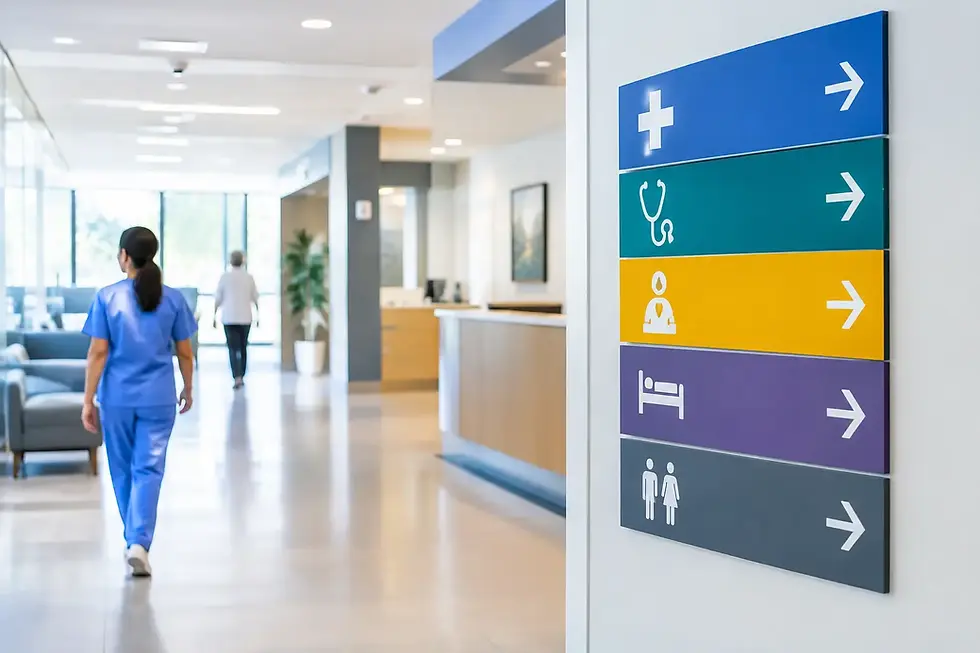
For organizations that need accessibility and navigation support, ADA and wayfinding signs are essential. These signs are not only about compliance. They also make spaces easier to use for staff, customers, and visitors. When designed well, they can support branding while still meeting functional requirements.
Materials, finish, and durability
A wall sign has to look good on day one, but it also needs to keep performing. Material choice affects appearance, durability, maintenance, and price.
Acrylic is popular because it offers a clean finish and strong color consistency. Metal can add durability and a more substantial look, especially in executive, hospitality, or institutional settings. PVC and other formed plastics can be cost-effective while still providing dimension and professional presentation. Printed panels and vinyl graphics offer flexibility for detailed artwork, messaging, and larger wall coverage.
The environment matters here. An interior wall sign in a climate-controlled office may allow for a broader range of materials and finishes. A sign near an entryway, in direct sun, or in a high-traffic public area may need tougher construction and finishes that resist wear. If you manage multiple locations, consistency also becomes a factor. Materials should be repeatable across sites without losing quality.
Trade-offs are real. A lower-cost option may meet a short-term need, especially for a temporary promotion or event. But for a main lobby or long-term branding feature, investing in stronger materials and better fabrication usually pays off in appearance and longevity.
Design decisions that make a difference
Good wall signage is rarely about one design element alone. It is the combination of scale, spacing, color, readability, and placement that makes the sign effective.
One of the most common issues is undersizing. Business owners sometimes approve a sign based on a proof without fully picturing how it will read on an actual wall. A sign that feels balanced on paper can disappear once installed in a larger lobby or open retail space. Mockups and site measurements help avoid that problem.
Color contrast matters too. A logo may be accurate to brand standards, but if it blends into the wall behind it, the sign will not perform as well. Lighting can either improve or weaken visibility. Matte finishes reduce glare in bright interiors, while some polished materials create a more upscale look if the lighting supports it.
There is also a branding question to answer early. Should the sign be subtle and architectural, or should it become a bold statement piece? Neither is automatically right. A professional office may want restraint. A retail business or event environment may benefit from more energy and visual presence.
Installation is part of the result
A well-designed sign can still disappoint if installation is not handled properly. Crooked mounting, poor spacing, damage to wall surfaces, or weak attachment methods can undermine the final presentation fast.
That is why installation should be treated as part of the project, not an afterthought. Surface conditions need to be checked. Mounting methods should match the material and the wall. Placement should account for sightlines, furniture, lighting, and how people move through the space.
This is especially true in commercial settings where schedules, property rules, and building access can affect the work. A full-service sign partner can coordinate those details, which saves time and helps prevent costly rework. For businesses that want one source for design, fabrication, installation, and future updates, that continuity matters.
How to choose the right sign partner
If you are investing in custom wall signage, it helps to work with a company that asks good questions before talking about products. The real issue is not simply what kind of sign you want. It is what the sign needs to achieve.
A good sign partner will look at your brand, your space, your timeline, and your budget. They should be able to recommend materials and construction methods that fit the job rather than pushing a standard option onto every client. They should also understand compliance issues when they apply and be able to carry a project from concept to installation.
That full-service approach is especially useful for growing businesses, property managers, and organizations with ongoing signage needs. It creates consistency over time and makes future additions easier. For companies in Sonoma County and surrounding Northern California markets, working with a local provider such as Econoline Signs often means faster communication, better site familiarity, and long-term accountability.
When wall signage is worth upgrading
If your current wall signage feels dated, inconsistent, or improvised, it is probably affecting how people see your business. That does not always mean you need the most elaborate option. It may mean refining scale, improving materials, updating branding, or replacing temporary graphics with something built to last.
The strongest wall signs do not call attention to themselves for the wrong reasons. They simply make your business look established, easier to navigate, and more professional. That is a practical return, not just a visual one.
A good wall sign should feel like it belongs exactly where it is. When that happens, customers notice your business, not the effort behind the sign, and that is usually the point.


Comments